Full disclosure up front: we make Pyor, so read this Pyor vs Stage comparison with that in mind. We will be fair to Stage, and being fair is easy here because Stage is the closest thing Pyor has to a philosophical rival. Most tools in this space either automate review away or drag you onto a new platform. Stage and Pyor do neither. Both keep a human in the loop and both try to make the actual review experience better. The whole comparison comes down to one honest line about how each one uses AI.
The one honest line: narrate versus point
Strip away the surface features and the difference is a single design choice. Stage narrates: it turns the change into chapters, adds an assistant, and gives you generated text that explains the diff. Pyor points: it groups and labels the diff and drops hints, but it does not write you a story about the code. Neither is obviously correct. Some reviewers orient best by reading a good explanation first. Others find any generated layer becomes a thing to double-check, because when the narration and the code disagree you still have to read the code. We built Pyor around the second instinct, and we are telling you that up front so you can discount it.
It helps to notice what both tools refuse to do, because that is where they are allies before they are rivals. Neither one automates the reviewer out of the loop, and neither one drags your team onto a separate platform or a new branching model. Both sit on your existing GitHub pull requests and both assume a person is still the one who approves. Against the wider field, that shared refusal is the headline, and the narrate-versus-point split is a quieter, second-order argument between two tools that already agree on the important thing.
What Stage does, and does well
Here is where the hedging matters, because Stage’s public site is sparse at the moment. As of this writing it shows only a tagline calling itself a better code review platform, so the specifics below come from earlier public information and should be read as of this writing rather than as confirmed current facts. Stage has been described as YC-backed and launched in 2026. As of this writing it turns a pull request into logical chapters with guidance, pairs that with an assistant it calls Stagent, syncs to GitHub, and offers a fourteen-day trial. The chaptering idea is genuinely clever: if a reviewer’s real problem is orientation, staring at an unfamiliar change with no map, a well-built narrated structure is a real answer to that.
Where Stage is genuinely the better pick
If you like being walked through a change, Stage is built for you and Pyor is not. A reviewer who wants to read what the author intended, in order, with an assistant standing by to ask questions of, will feel more at home in a narrated tool. That is a real preference, not a lesser one. Onboarding reviewers to an unfamiliar codebase, reviewing a domain you do not know well, or simply preferring prose over a terse map are all cases where narration earns its keep. As of this writing Stage leans into exactly that, and if a guided story is what makes review click for you, you should try Stage and trust your own experience over our pitch.
What Pyor does differently
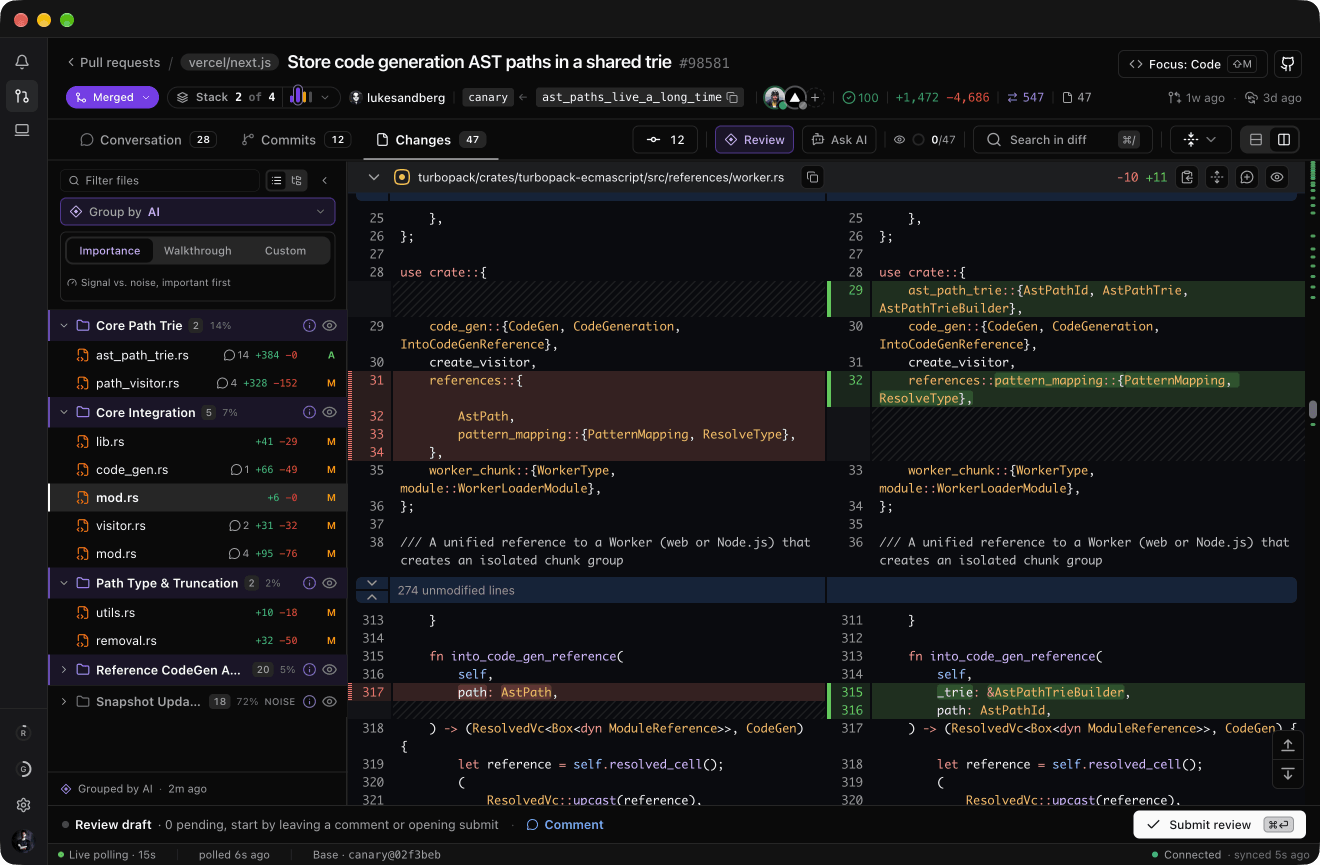
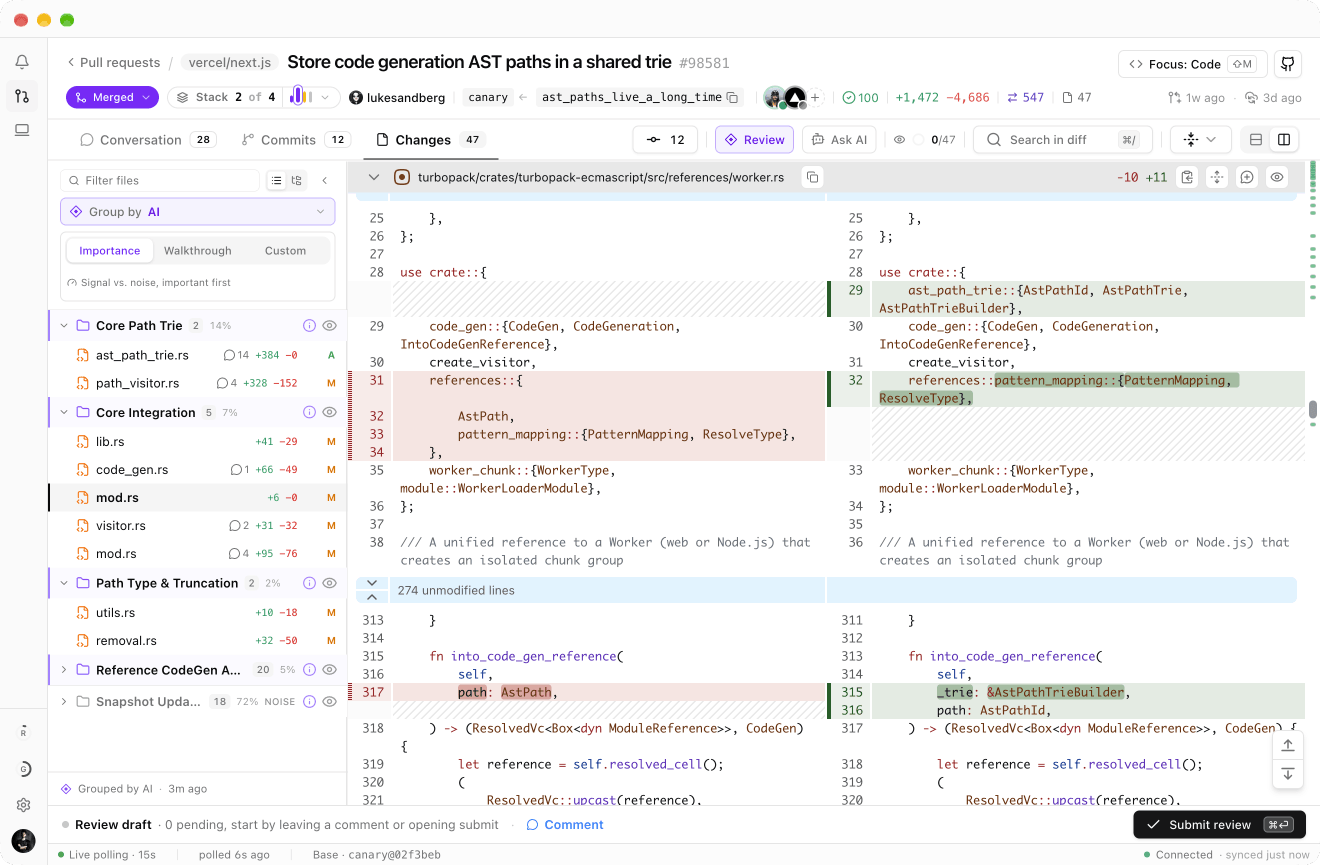
Pyor makes the same bet about keeping a human in the loop, then takes the opposite approach to AI. It is a web-first surface for GitHub PRs with a macOS, Windows, and Linux desktop app, where you read, comment, approve, and merge without opening github.com. Its AI organizes rather than narrates: it groups review-worthy changes apart from the noise, labels each group in one line, and adds short steering hints that point at what deserves attention first, with an optional walkthrough that orders the review. It does not generate chapters or summaries for you to read and then re-check; its chat answers only the questions you ask. The surface carries the rest: folder-level viewed tracking, focus mode, threads that survive force-push, a comments inbox, and commit-scoped diffs so a re-review costs only the delta. The philosophy behind pointing instead of narrating is the same one we argue in what AI should actually do in code review.
Pyor’s honest caveats
Pyor is young, and it is a review surface, not a workflow platform: it does not create stacks and has no merge queue of its own (it adds PRs to GitHub’s merge queue when a repo uses one, and it now surfaces GitHub’s native stacked PRs so you can navigate one while you review), with org features paid per seat and individual use free. And the narrate-versus-point line cuts both ways. If you genuinely review faster with a written guide, Pyor’s refusal to generate one is a feature you will experience as a gap. We think less text between you and the code is the right default when you are reviewing large pull requests, but that is a preference, not a proof, and a fair comparison has to admit that Stage’s bet could be the better one for you.
Pyor vs Stage at a glance
| Pyor | Stage | |
|---|---|---|
| What it is | A review surface that organizes the diff | A review surface that narrates the diff (as of this writing) |
| Approach to AI | Signal-vs-noise groups, one-line labels, steering hints, chat on request, no PR summary | AI chapters plus a Stagent assistant (as of this writing) |
| Best for | Reviewers who want pointing, not text to verify | Reviewers who want a guided narration of the change |
| Pricing | Free for individuals (AI on your own key); per-seat for orgs, 30-day trial, no card | Fourteen-day trial, then paid (as of this writing) |
| Caveat | Young; writes no summary of your PR by design | Public details are sparse as of this writing |
How to choose
- Do you orient best by reading a good explanation? Lean Stage. Narrated chapters and an assistant are its whole thesis.
- Does every generated layer become one more thing to verify? Lean Pyor. It points at the code and adds nothing to read.
- Not sure? Both sync to GitHub. Try each on one real pull request and trust the experience over either pitch.
This is the closest call in the category, and the honest answer is that it comes down to how you like to read a change. If you want the wider set of options, we keep an honest field guide to the alternatives, and there is a separate head-to-head with Graphite if workflow, not narration, is your question.
Frequently asked questions
How are Pyor and Stage different?
Both improve the review experience rather than automate it away, which makes them close in spirit. The difference is style. As of this writing Stage narrates the diff into AI chapters with a built-in assistant, while Pyor groups review-worthy changes apart from the noise, adds steering hints, and writes no summary of your PR for you to read and verify; its chat answers only when you ask.
Does Pyor generate written summaries of a pull request?
No. Pyor writes no summary of your PR for you to read and check against the code; its chat answers only when you ask. Its AI groups review-worthy changes apart from the noise, labels each group in one line, and points you at what matters with short hints. A reviewer who wants a written, narrated guide through the change may genuinely prefer Stage.
Which one should I try first?
Try the one that matches how you like to review. If you want a guided narration that walks you through the change, start with Stage. If you want a fast surface that organizes the diff and points without adding text to read, start with Pyor. Both sync to GitHub, so trying one on a real pull request costs little.