Full disclosure up front: we make Pyor, so read this Pyor vs CodeRabbit comparison with that in mind. We will be fair to CodeRabbit, because it is very good at what it sets out to do, and what it sets out to do is not what Pyor does. This is the rare comparison where the two tools are barely in the same category. CodeRabbit is an AI reviewer that reads your pull request and comments on it. Pyor is a surface where a human reviews the pull request faster. Understanding that split is most of the decision.
Two different jobs, not two versions of one
Most comparison pages pit two near-identical products against each other. This one cannot honestly do that. CodeRabbit automates the act of reviewing: it stands in as a reviewer and produces output. Pyor assumes a human is still doing the reviewing and tries to make that human faster. Those are different jobs. You can hold the opinion that AI should do the reviewing, in which case CodeRabbit is your category, or the opinion that AI should assist the human reviewer, in which case Pyor is. We hold the second opinion, but we build the second kind of tool, so weigh that accordingly.
The practical consequence is that adopting them feels different. An automated reviewer is a repo-level decision: it posts comments everyone on the pull request sees, so turning it on is a team choice with a shared blast radius. A review surface is a personal decision: one reviewer can adopt it on the pull requests they own without asking anyone else to change a thing. That difference in how you try each tool matters as much as the feature lists, because it decides who has to agree before you can even start.
What CodeRabbit does, and does well
CodeRabbit calls itself the leader in AI code reviews, and the breadth backs the claim. It works across GitHub, GitLab, Azure DevOps, and Bitbucket, plus IDEs like VS Code, Cursor, and Windsurf, and a CLI. It does bug detection, flags architectural impact, offers one-click fixes, and generates summaries, walkthroughs, and diagrams. It runs more than forty linters, takes YAML configuration, pulls Jira and Linear context, adapts to your team through learnings over time, and can generate tests and docstrings. It carries SOC 2 Type II and zero data retention after a review, has a free trial with no card, an open-source program, and an enterprise tier. If you want an automated reviewer leaving structured comments on every PR, it is genuinely built for exactly that, and it is thorough about it.
Where CodeRabbit is genuinely the better pick
If your problem is that pull requests reach human review with obvious issues still in them, an automated reviewer that runs first is real value, and CodeRabbit is one of the strongest. It never gets tired, it applies the same checks to the two thousandth line as the second, and it catches mechanical mistakes before a person spends attention on them. For teams that want coverage on every PR regardless of who is around to review, or that lean on the linter breadth and the test generation, Pyor simply does not offer that, because it does not try to. A team that wants a tireless first-pass reviewer should pick CodeRabbit without apology.
The tradeoff worth naming fairly
Every automated reviewer lives with the same tension: catch more, and you also surface more that does not matter. False positives and comment volume are the real cost, not a cheap shot at any one product. We wrote about the accuracy ceiling in how accurate AI code review actually is and about the human cost of noisy output in review alert fatigue. CodeRabbit invests heavily in learnings and configuration precisely to keep that in check, which is the right response. The point is not that bots are bad. It is that an automated reviewer trades some signal-to-noise for coverage, and a human still has to triage what it produces, which is its own kind of reading.
What Pyor does differently
Pyor does not review your code. It makes the human review faster. It is a web-first surface for GitHub PRs with a macOS, Windows, and Linux desktop app, where you read, comment, approve, and merge without opening github.com. Its AI organizes the diff rather than commenting on it: it groups review-worthy changes apart from the noise, labels each group in one line, and adds short steering hints that point you at what deserves attention first, with an optional walkthrough. It never adds a wall of generated text you then have to verify. The rest of the surface is built for the same goal: folder-level viewed tracking, focus mode, threads that survive force-push, a comments inbox, and commit-scoped diffs so re-review costs only the delta. Since a human is still reading, the usual discipline of reviewing AI-generated code still applies.
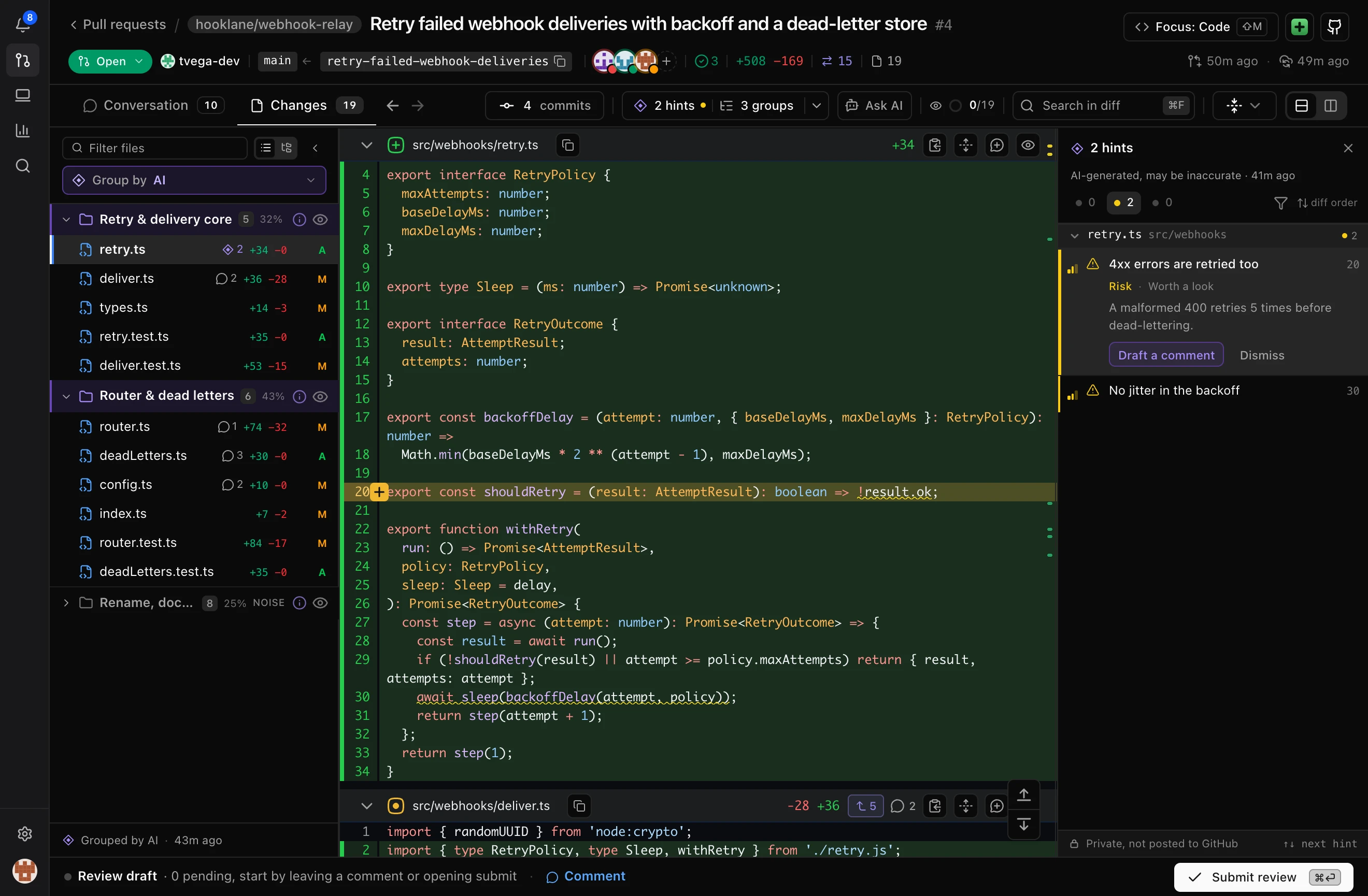
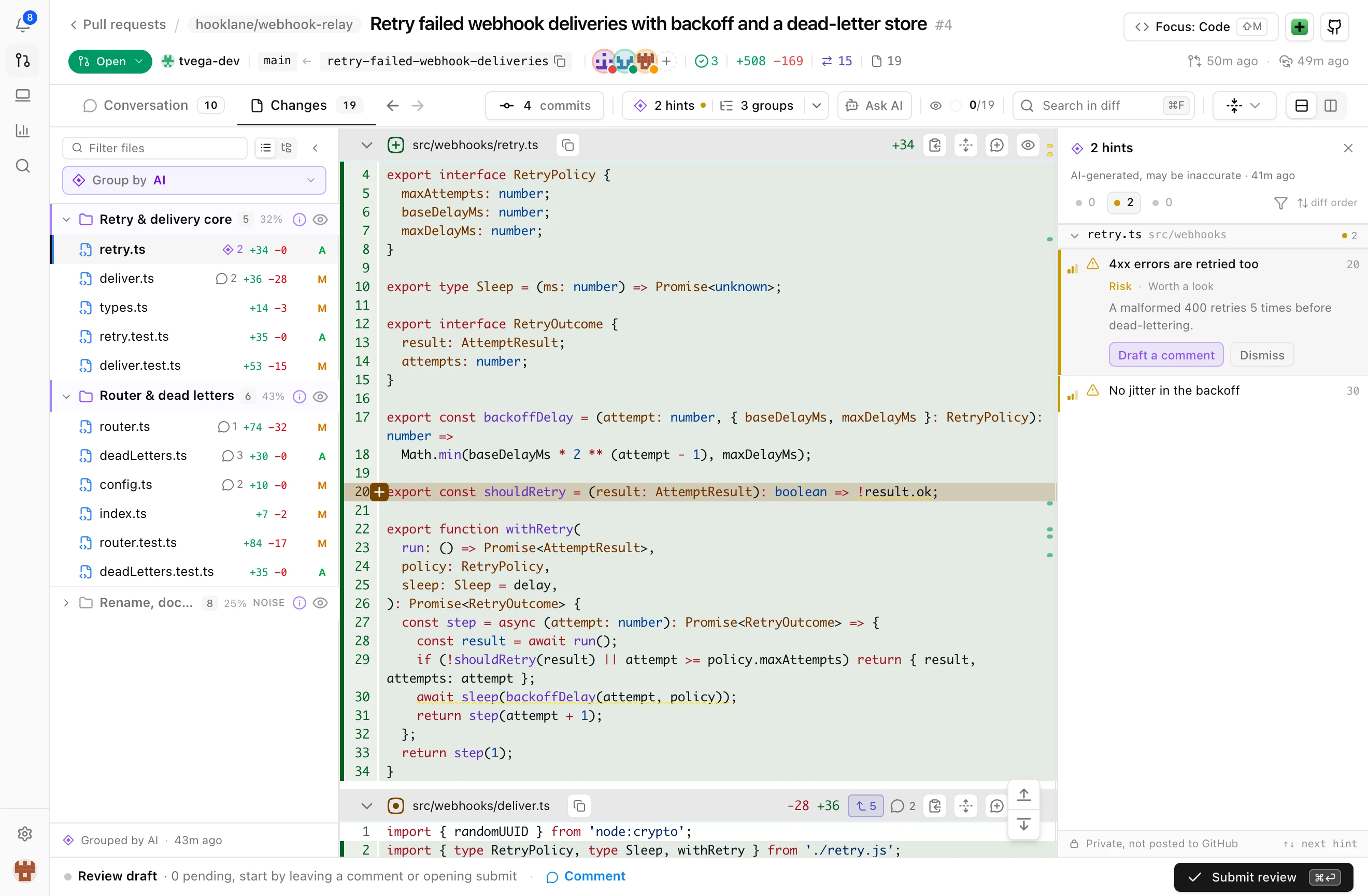
Pyor vs CodeRabbit at a glance
| Pyor | CodeRabbit | |
|---|---|---|
| What it is | A human review surface with AI triage | An automated AI reviewer that comments on PRs |
| Approach to AI | Organizes the diff: signal-vs-noise groups, one-line labels, hints | Generates comments, summaries, walkthroughs, and fixes |
| Best for | When a human reading the diff is the bottleneck | When you want a tireless automated first-pass reviewer |
| Pricing | Free for individuals (AI on your own key); per-seat for orgs, 30-day trial, no card | Free trial, no card; paid tiers up to enterprise |
| Caveat | Young; does not review or comment for you | Adds comment volume a human still has to triage |
How to choose
- Want issues caught automatically before humans look? That is CodeRabbit. It is a reviewer that comments, and Pyor is not.
- Is the bottleneck a person slowly reading a large diff? That is Pyor. The AI triages so the human reads the right code first.
- Want both? Run CodeRabbit as a first pass and review the result in Pyor, as long as the extra comments are worth it.
The two are not really rivals so much as answers to different questions. Decide whether you want the review automated or the reviewer accelerated, and the pick follows. For the wider landscape, we keep an honest field guide to the alternatives, and if the deeper question is who should catch what, see what AI should actually do in code review.
Frequently asked questions
Are Pyor and CodeRabbit the same kind of tool?
No, they are different categories. CodeRabbit is an automated AI reviewer that reads a pull request and posts its own comments, summaries, and suggested fixes. Pyor is a human review surface with AI that triages the diff for the person doing the reading. One acts as a reviewer, the other speeds up your reviewer.
Does Pyor leave automated review comments like CodeRabbit?
No. Pyor never posts its own review comments on a pull request. Its AI groups review-worthy changes apart from the noise, with one-line labels and steering hints, so a human reviews the important parts first. If you want a bot that catches issues and comments automatically, CodeRabbit is built for that and Pyor is not.
Can a team use both CodeRabbit and Pyor?
Yes, and some will. CodeRabbit can run a mechanical first pass that catches obvious issues before a human looks, while Pyor makes the human review of the same pull request faster. They sit at different points in the flow, so using both is reasonable if the extra comment volume is worth it to your team.