Disclosure before anything else: we build one of the tools on this list, Pyor, so read the whole thing accordingly. With that on the table, this is our honest map of the best code review tools in 2026: nine entries across four categories, each with what it is, who it fits, and the caveat the vendor page leaves out. For a deeper head-to-head on the GitHub alternatives specifically, see our earlier comparison.
| Tool | Approach | Best for | Pricing model |
|---|---|---|---|
| GitHub built-in | PR reviews on the code host | Small diffs, default workflow | Included with GitHub |
| GitLab MRs | Merge requests with approval rules | Teams already on GitLab | Included with GitLab |
| Gerrit | Patchset-per-commit review | Commit-level discipline | Free, self-hosted |
| Graphite | Stacked PRs, merge queue, AI review | Teams adopting stacking | 30-day free trial, then paid |
| Stage | AI chapters over the diff | Orientation in unfamiliar changes | Paid; details light as of this writing |
| CodeRabbit | AI review comments on the PR | Mechanical first pass | Free trial; free for open source |
| Copilot code review | AI first pass inside GitHub | GitHub-native teams | Copilot subscription |
| Pyor (ours) | Fast surface, AI triage not narration | Reading big diffs is the bottleneck | Free for individuals (AI on your own key); per-seat orgs |
| Local checkout | Pull the branch into your editor | One gnarly change | Free |
The platforms: GitHub, GitLab, and Gerrit
GitHub built-in review is the default for a reason: zero setup, and every integration assumes it. It works well for small, focused PRs. The caveat is scale: large diffs paginate and collapse, and there is no triage, which is why teams eventually look elsewhere. GitHub is moving: it added native stacked pull requests in 2026, per InfoWorld, with GitHub itself admitting that large pull requests are hard to review.
GitLab merge requests add approval rules, required reviewers, and pipeline gates in one place. Best for teams already on GitLab; the review surface itself has the same wall-of-diff problem as GitHub. Gerrit is the veteran: every commit becomes a reviewable change with numbered patchsets and explicit vote labels, which is why large projects like Android still run on it. Caveats: an austere UI, a real learning curve, and you host it yourself.
The workflow layer: Graphite and stacked pull requests
Graphite now positions itself as an AI code review platform, but the durable idea is stacking: break a big change into a sequence of small dependent PRs, with a CLI, a stack-aware merge queue, and a PR inbox doing the bookkeeping. The research on small changes is firmly on its side. Honest caveats: stacking is a team-wide workflow change with a learning curve, it cannot shrink genuinely atomic changes (migrations, codemods), and you are adopting a platform, not a viewer. As of this writing it offers a 30-day free trial, no credit card required.
The AI reviewers: CodeRabbit and Copilot code review
CodeRabbit posts AI review comments directly on the PR across GitHub, GitLab, Azure, and Bitbucket, with diff summaries, configurable rules, and a feedback loop it calls Learnings. It is the most built-out of the bot reviewers, free for open source, with a no-card trial. GitHub Copilot code review does the same job natively inside github.com for teams already paying for Copilot. The shared caveat for the whole category: bots are a first pass, not a reviewer. Independent audits of AI review accuracy keep finding a large linter-grade and false-positive share, and every comment the bot posts is volume a human still triages.
The guided surfaces: Stage and Pyor
Stage bills itself simply as a better code review platform: AI organizes the diff into logical chapters with guidance, and everything syncs back to GitHub. If reviewers feel lost in unfamiliar changes, chaptering is a genuinely clever fix. Caveats: you are reading generated narration and trusting it, and public pricing detail is light as of this writing.
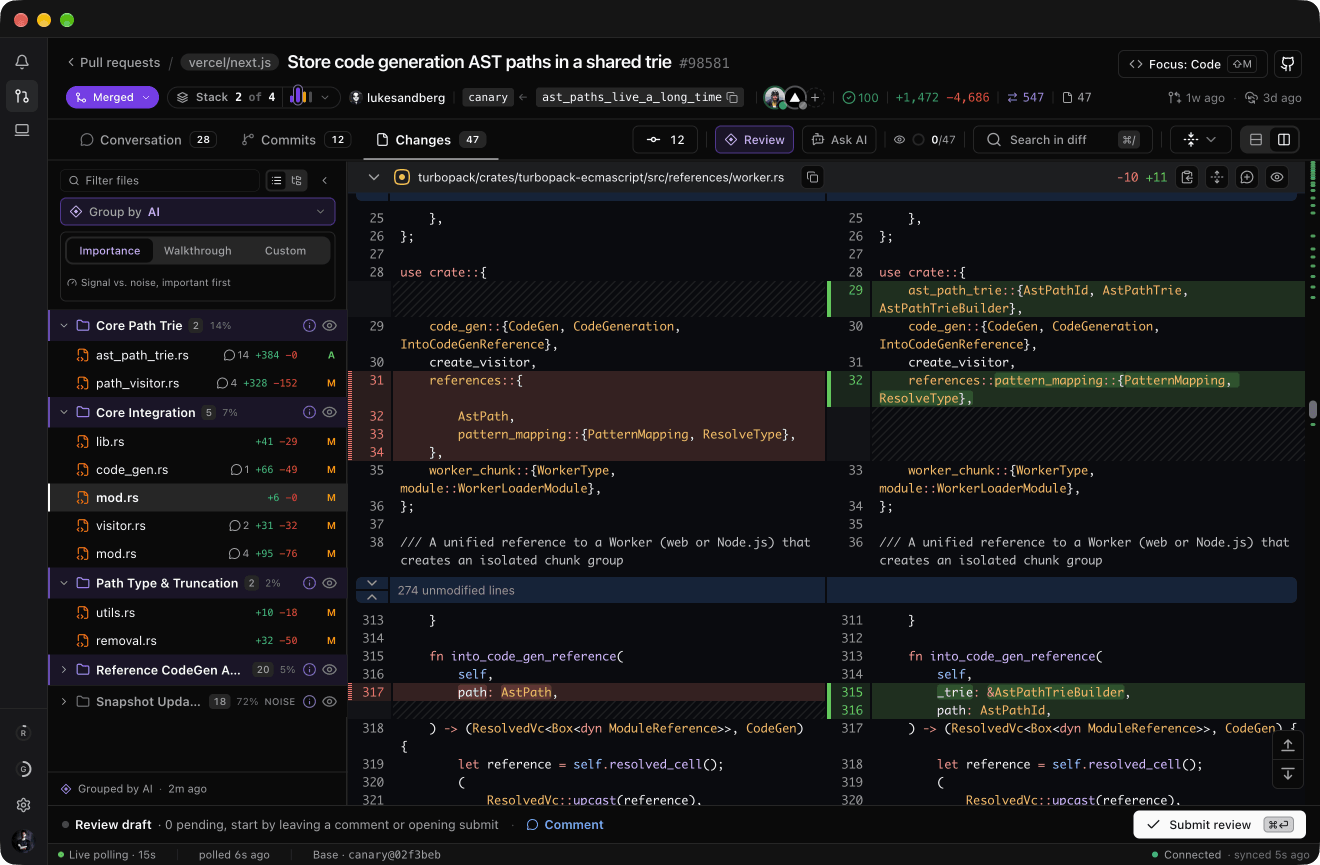
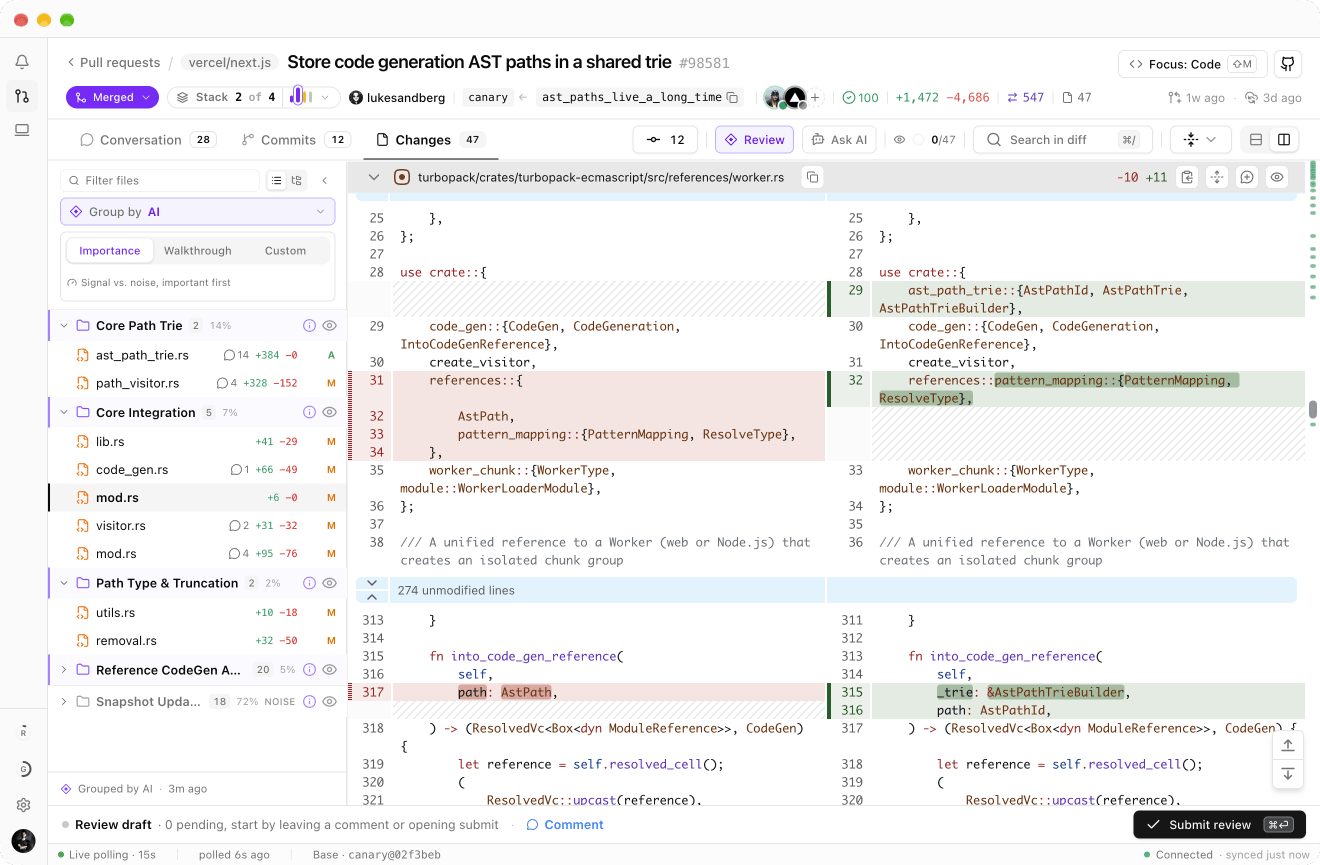
Pyor is ours, so the claims stay modest and checkable. It is a fast review surface for existing GitHub PRs: read, comment, approve, and merge in one window, with a file rail built for triage and diffs that stay navigable at any size. Where it uses AI, the AI organizes rather than narrates: it groups review-worthy changes apart from the noise, labels each group in one line, and drops short hints pointing at what deserves attention first. It does not generate summary prose you must read and then re-verify. Honest caveats: it is young, and it is a viewer, not a workflow platform: it does not create stacks and has no merge queue of its own (it adds PRs to GitHub’s merge queue when a repo uses one), though it now surfaces GitHub’s native stacked PRs so a stack stays navigable while you read. Free for individuals (AI on your own key), per-seat for organizations.
The free baseline: pull the branch locally
git fetch && git checkout remains the zero-dollar power move: full editor navigation, jump-to-definition, run the tests. Every paid tool on this list should be measured against it. The cost is friction: you stash your own work, lose inline commenting, and transcribe findings back by hand. Right for one gnarly architectural change; wrong as a daily default.
The best code review tools by situation
- Diffs are too big and the team will change workflow: Graphite, or GitHub’s now-native stacking.
- Diffs are too big and the workflow will not change: a better surface: Stage if you want narration, Pyor if you want triage and pointing.
- Mechanical issues reach humans too often: CodeRabbit or Copilot code review as a gate, tuned aggressively for noise.
- You need commit-level rigor and control: Gerrit.
- One brutal change, once: pull it locally and keep your money.
A note on what this list deliberately leaves out: linters, static analysis, and security scanners. They are gates, not review tools; they belong in CI, where they run without spending anyone’s attention, and a healthy pipeline means your human reviewers and your AI reviewers never comment on anything a machine could have rejected for free. If a bot on this list is mostly restating linter findings, the fix is a linter, not a subscription.
Most of these compose. A realistic 2026 stack is a platform you already have, one bot as a filter, and one surface that makes the human read fast. The cheapest experiment is one reviewer trying one tool on one real PR this week: every entry here syncs back to the platform, so nothing about trying them commits your team to anything. Trial before you involve the whole team, and measure turnaround before and after so the decision is a number, not a vibe.
Frequently asked questions
What is the best code review tool overall?
There is no single winner because the tools solve different problems. Graphite restructures the workflow so diffs stay small. CodeRabbit and Copilot add an automated first pass. Stage and Pyor upgrade the reading surface. GitHub, GitLab, and Gerrit are the platforms underneath. Pick by bottleneck: workflow, mechanical checks, or the reading itself.
Are AI code review tools worth it?
As a mechanical first pass, yes: they catch obvious bugs and style drift before a human looks, and they are cheap to try. They are not a replacement for human review. Independent spot checks find a meaningful share of AI suggestions to be linter-grade or wrong, so treat bot output as a filter, not a verdict.
Do I need a separate tool if my team already uses GitHub?
Not necessarily. GitHub review is fine for small, well-scoped pull requests. Teams reach for extra tooling when a specific failure shows up: diffs too large to read on github.com, review turnaround stretching past a day, or bot and human comments drowning each other out. Adopt a tool for the failure you actually have.
